

5 min read
Bacteria Inhibition in Processed & Refrigerated Meat | GPI
Bacteria Inhibition in Processed and Refrigerated Meat: A Clean-Label Approach
4 min read
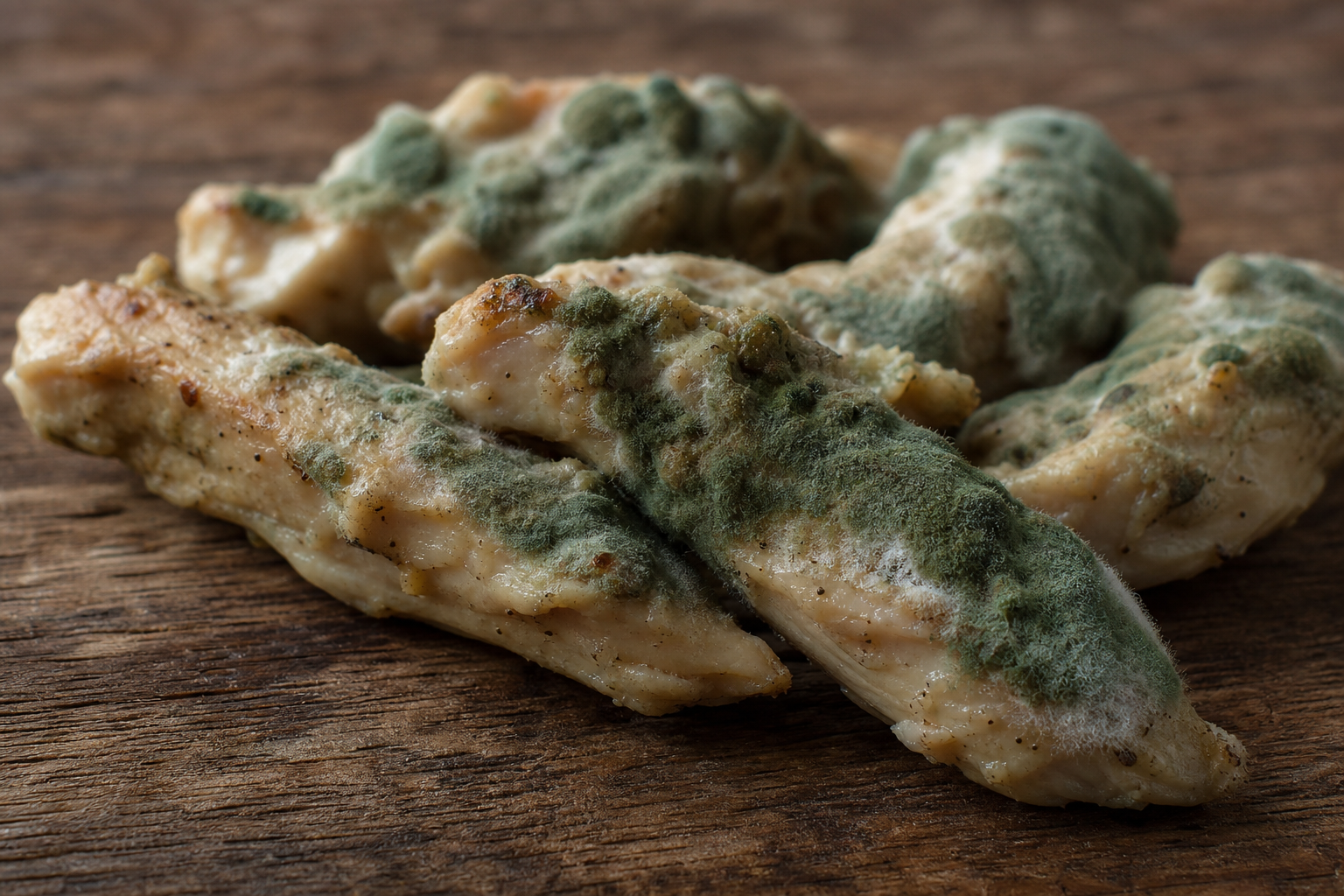
Mold is the spoilage organism your customer sees.
Bacteria can climb well past the safety threshold while a product still looks appetizing. Mold doesn't work that way. The moment a colony becomes visible, the product is discarded — by the shopper, by the retailer, by the grocery manager walking the case. Whether it was ever unsafe is irrelevant.
For most of a century, the default answer has been calcium propionate. It is effective, cheap, and increasingly unwelcome on a label that consumers read.
The good news for formulators: mold inhibition with a natural, organic compatible ingredient isn't a compromise. In head-to-head trials, vinegar-based systems have outperformed calcium propionate outright.
Calcium propionate works by delivering propionic acid, which disrupts fungal metabolism. It's been the workhorse mold inhibitor in bakery for generations.
Two forces are pushing processors away from it. The first is labeling: it reads as a chemical additive, and clean-label reformulation programs target it early. The second is functional — in yeast-leavened products, propionate can interfere with fermentation, suppressing proofing and costing volume.
Any replacement has to clear both bars. It must inhibit mold at least as well, and it must not create a new problem in its place.
A study evaluated a liquid, near-neutral pH vinegar antimicrobial against calcium propionate and a competitor product, inoculated with Penicillium roqueforti and held at 20–25°C to simulate temperature abuse.
Days until visible mold:
| Treatment | Days without mold |
|---|---|
| Untreated control | ~5 days |
| 2% lemon juice concentrate | 6 days |
| 0.2% calcium propionate | 13 days |
| 2% competitor product | 13 days |
| 0.3% liquid vinegar antimicrobial | 19 days |
The natural antimicrobial delivered roughly six additional days over calcium propionate, and nearly four times the mold-free life of the untreated control — under abusive temperature conditions, not ideal ones.
Sensory results mattered as much as the microbiology. The control, the calcium propionate sample, and the vinegar antimicrobial samples were all judged similar in taste: mild and slightly acidic. Treatments that achieved mold control through aggressive acidification, by contrast, were rated too sour by the panel.
Low pH does extend shelf life. It also ruins the eating experience. The balance is the entire point.
The same comparison was run under refrigeration (3–10°C), on an inoculated refrigerated filling.
Days until first visible mold:
| Treatment | First visible mold |
|---|---|
| Untreated control | Day 24–25 |
| 2% competitor product | Day 28 |
| 0.2% calcium propionate | Day 29 |
| 0.3% liquid vinegar antimicrobial | Day 33 |
| 0.18% dry powder vinegar antimicrobial | Day 55 |
Two findings deserve attention.
First, the liquid vinegar antimicrobial again beat both calcium propionate and the competitor. Second — and more striking — the dry powder blend of dried vinegar solids and cultured dextrose extended mold-free life to day 55, more than doubling the control and adding roughly 34 days of shelf life.
Format matters. So does dose. The powder achieved its result at 0.18%.
For refrigerated ready-to-eat products, mold is rarely the only problem. A 65-day modified-atmosphere study on a refrigerated prepared food measured the same dry-powder vinegar and cultured dextrose blend against an untreated control:
One clean-label dry powder delivering both mold inhibition and bacteria inhibition simplifies a formulation that would otherwise need two ingredients — and one fewer line on the label.
The functional trap in bakery reformulation is fermentation. An effective mold inhibitor added at the dough stage can also inhibit the yeast you need for proofing, costing volume and crumb structure.
Encapsulation solves this. An encapsulated mold inhibitor stays inert through mixing, fermentation, and proofing — letting yeast-leavened breads rise normally — then releases its active during baking, where it goes on to prevent mold growth through storage and distribution.
In white bread trials, an encapsulated system matched calcium propionate on both loaf volume and mold-free days. In rye bread, results were comparable. Processors get clean-label mold inhibition without paying for it in yield or appearance.
For natural and organic product lines, certification status determines whether an ingredient is usable at all.
GPI's liquid vinegar antimicrobials are available in USDA Organic–certified versions. The platform is non-GMO, kosher, and halal. Dry powder options are available for processors who prefer a blended dry ingredient.
The label declaration is short: vinegar, or vinegar and cultured dextrose. At low usage levels, these ingredients can often be declared as a processing aid rather than as an ingredient — though this depends on your jurisdiction, and should be confirmed with your regulatory team before label copy is locked.
It does!
These mold-inhibition studies were run in bakery and prepared-food matrices. But mold chemistry does not respect category boundaries: the same vinegar-based actives that inhibit Penicillium in a refrigerated filling are relevant to marinated, coated, and refrigerated meat, and to surface-mold control on cured products.
What changes across matrices is not the mechanism but the dose. Fat content, water activity, surface pH, and packaging atmosphere all shift the effective level. Published trial data tells you the ingredient works; it does not tell you what your product needs.
Validate in your own matrix. Run a bench trial at two or three doses, then confirm the winner in a plant trial with your sensory panel.
What is the best natural alternative to calcium propionate? In controlled trials, a liquid near-neutral pH vinegar antimicrobial at 0.3% delivered 19 mold-free days under temperature abuse, versus 13 days for 0.2% calcium propionate — while scoring comparably in sensory evaluation.
Can natural mold inhibitors be organic compatible? Yes. GPI's liquid vinegar antimicrobials are available in USDA Organic–certified versions, and are non-GMO, kosher, and halal.
Will a mold inhibitor stop my bread from rising? An unencapsulated inhibitor can suppress yeast during proofing. Encapsulated systems remain inert through fermentation and release the active during baking, so yeast-leavened breads rise normally.
Can one ingredient handle both mold inhibition and bacteria inhibition? Yes. In a 65-day MAP study, a dry powder blend of dried vinegar solids and cultured dextrose held yeast and mold below detection at 0.5% while suppressing total coliform to 0.85 log CFU/g.
Do mold inhibition ingredients work in meat? The mechanism transfers to marinated, coated, and refrigerated meat, and to surface-mold control on cured products. Effective dose varies by matrix — validate in your own product.
Mold inhibition is matrix-specific. Tell our technical team about your product, your process, and your target shelf life — we'll recommend an ingredient, a format, and a starting dose.
Contact us → or explore the full antimicrobial portfolio.
5 min read
Bacteria Inhibition in Processed and Refrigerated Meat: A Clean-Label Approach
6 min read
Natural Antimicrobials for Shelf-Life Extension: A Guide for Meat Processors

4 min read
At Gum Products International Inc. (GPI), we’ve always believed that clean-label innovation and strong food safety go hand in hand. That’s why I’m...